After days and days of awakening to the usual clear blue skies and warm sunshine, it was a more overcast start to our morning, on the day that we decided to head out on a short mini-adventure. Now this trip had not been one of those spontaneous decisions, pre-empted with a morning conference call on the balcony with Shazza, no starting gambit by her of “What do you want to do today”, we hadn’t actually had any of those for some time now, what with Shazza these days more than content with her new life here, and of course with us no longer being on a strict ninety-day time schedule. So although there was no formal handing over of the baton ceremony, it would appear that the responsibility to take over the mantle of planning any ‘Adventures’ has been put onto my shoulders. Of course, there was no way that my OCD buddy would ever permit me to make spontaneous decisions, not that any of Shazza’s previous adventures were really that spontaneous, she had always planned them in advance and kept them to herself, the only short notice notification was when she decided to inform me of them. So, although over the last couple of months I have been actively researching and planning some future, more extended, travel itineraries, this particular ‘mini-adventure’ had also actually been on the cards for a good couple of weeks, only the weather, and ‘other’ domestic type priority commitments, had delayed this particular departure.
We have already travelled a lot of the Atlantic coast over the last nine years or so, both in Portugal and here in Spain, most of it during the course of our more nomadic Motor homing days, but we had also visited some parts of the Cadiz Province coastline on day trips, when we had come across to stay at our ‘Bolt Hole’ from the UK with our car. Much like the Mediterranean side of the coast, the Western Atlantic side, although more rugged, also has its own spectacular landscapes, with fantastic long golden stretches of sandy beaches along with the usual historic Villages, Towns and Cities and also several National Parks. However, the Atlantic coast is notorious for experiencing very much more wilder weather, battered frequently by storms originating many thousand of miles away and carried across on the Gulf Stream from the Eastern seaboards of America, so that meant that some consideration to the weather conditions along that coastline was an essential part of any trip planning. So, provided that the ‘Works of Fiction’ was to get its ‘forecast’ at least somewhere near correct, my fingers were crossed that I had selected the right day for our particular trip, with shorts and short sleeve shirts being the dress code for the day, and no picnic lunch required, as I had planed to find somewhere nice to have lunch.
Although we have already driven along the majority of this particular stretch of the Atlantic coastline, from Huelva in the North, right down to Tarifa in the South, we hadn’t stopped and visited every single location along that stretch of coastline and, as I particularly like coastline locations, there were still a number of places that I wanted to visit. I guess the same could be said of our own Mediterranean side, from Gibraltar right up to Malaga, however, the majority of locations along that stretch are primarily full of tourist hotels, private beach clubs, Villas, Private apartment complexes, numerous golf courses and of course campsites. But it is still possible to find the secluded bays, if you are adventurous enough, and prepared to traverse rough and uneven stone tracks, which are only really generally suitable for four-wheeled vehicles, although it has to be said that all types and sizes of Motorhomes, and Camper Vans, appear to always manage to find such hidden gems, if only they would learn to stop sharing such idyllic secret hideaways, then they may remain idyllic and secluded 😉
I have actually wanted, for some time now, to go across to look at the ‘Faro D Trafalgar’, a lighthouse, and you may well ask ‘Why’ ? Knowing by now that we are both self-confessed history heathens, but Lighthouses and Castles just hold a certain fascination for me, although perhaps not so much for Shazza, but if their is a chance of a lunch thrown in, that she has not had to prepare and cook, then she is generally up for a ride out in the car. This particular lighthouse was located almost directly on a beach, surrounded by sand dunes, as opposed to being hundreds of metres up above the sea and sat precariously on a cliff edge. Apart from the history of such places, I actually enjoy the romanticism of them, I find myself imagining what it must have been like to have lived in one, making sure that the lenses of the massive lamp were always clean and that the lights remained serviceable and of course lit, then sitting inside the thick brick walls listening to the raging storm outside, the storm force winds whistling and the raging waves banging on the doors and windows. Unfortunately these days, not many lighthouses are actually permanently manned. Most being automated and managed remotely, with only the occasional routine visits for maintenance purposes. So, for those of you that may be interested in the more historical related facts, I have once again enlisted the help of ‘Mr Google’ to supply a little bit of background for you, yes I know, you don’t have to say it, I am good like that 😁

During Roman times, it was the site of a temple dedicated to the god Juno. Many divers claim to have seen its remains and, in particular, its sacrificial altar, beneath the surface at Cape Trafalgar. Later on, in the ninth century, the Muslims built a settlement whose remains lie next to the lighthouse. In 1805, one of the most famous and bloody battles in history took place. French and Spanish ships clashed against the British fleet of Admiral Nelson, (he led them to victory in some six hours, although he died from a gunshot wound that same afternoon). During the battle, 60 ships bombarded and collided with one another, with some sinking to the bottom of the ocean floor on the Cádiz coast. With over 5,000 dead and 4,000 injured, the splendour of the Spanish navy was finally finished with.
In 1860, little over half a century after the famous battle, Trafalgar Lighthouse was erected in this place but long before the battle of Trafalgar, pirates of Berber origin used to attack the area, and, in order to defend against them, Philip II built a watchtower (whose archaeological remains can still be found). Nevertheless, they were not the first, as the Romans had already established a fish nursery and salting factory long before.
So, as you all well know, road trips are not always about the final destination but more about the journey getting there. There were three potential routes to our destination, although there was only a difference of twelve minutes between the three of them and, as I would be doing the driving on the outbound portion of the trip, I chose the shortest, as far as Kilometres were concerned, although, contrary to what the map below may show, it wasn’t necessarily the quickest, but quite conveniently this route would take us through the central part of the ‘Parque Natural Los Alcornocales’. Unlike the two alternative routes, it would entail driving on more quieter rural roads, side by side with nature, which is far more enjoyable to drive than the often boring dual-carriage ways.
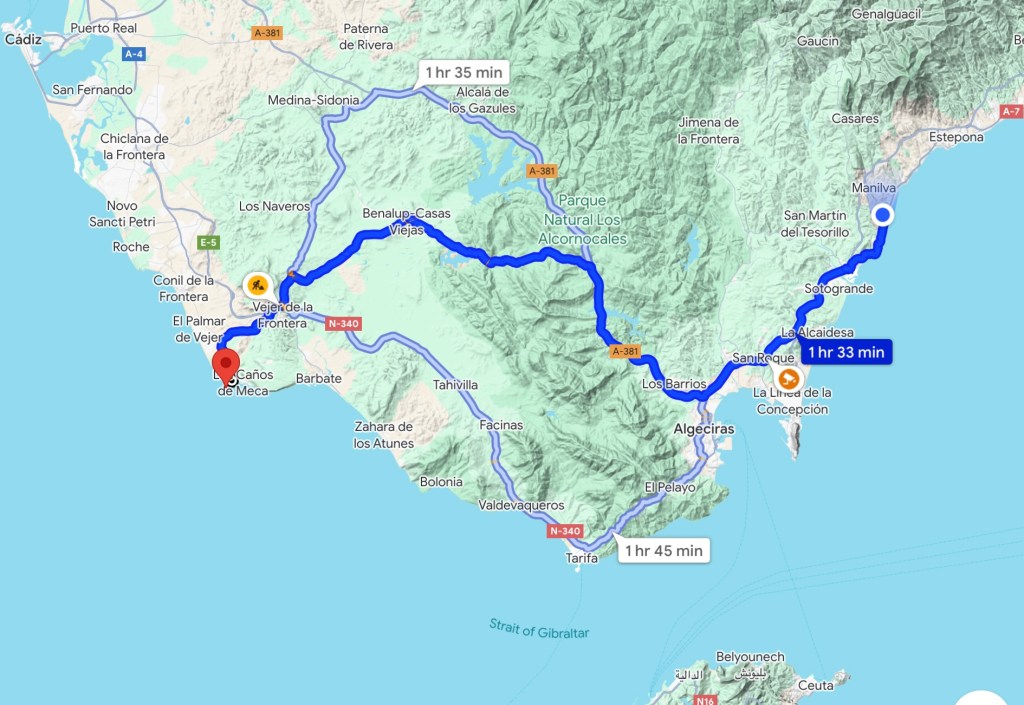
We had to initially take the A7 South towards Los Barrios before joining the dual carriage way along the A381, which is a very familiar stretch of road to us and one that, on another day, would have taken us as far as Jerez de la Frontera, before turning on to the A4 Motorway Northwards to Seville, then on up to the ferry ports at either Santander or Bilbao. However, this time we would only be going a short way along the A381 before turning off to go cross country. Although it had been 18 degrees(c) and a little overcast when we departed home that morning at 10:00am, by the time we reached the turn off on the A381 ‘the sun had got his hat on and was coming out to play’, the country road was ghostly quiet, very winding and undulating with no safety edges or barriers along the road, so their was no room for lack of concentration, misjudging a curve in the road could be disastrous, but it was an exciting route to drive and I thoroughly enjoyed it, Shazza on the other hand is actually quite a nervous passenger at the best of times, even on much wider and straighter roads, more to do with her not being in control than my actual driving abilities, and I had to smile to myself when I saw her leg keep pushing down on an imaginary brake pedal when we approached bends in the road 😂
Now I know that I may possibly be showing my ignorance here, but I have always associated Spain with traditional home grown produce such as, Olives, Oranges, Lemons, Apples, Grapes, Pomegranates, Almonds, Tomatoes, Peppers, well basically all of the fresh produce that you see growing around the normal Spanish countryside and which is all readily available on the supermarket shelves, the only exception to that being that in some parts of Spain they even grow the type of rice that is used for making the traditional Paella dishes. So what I am attempting to say is that I am more used to driving and seeing hectares of Olive groves, as far as the eye can see, or orchards laden with their numerous different fruits, from the brightly coloured Oranges that stand out amongst their surrounding deep vivid green leaves, or the citrus yellow of the Lemons, the green Apples and Pears. Additionally, driving through the more elevated areas and rockier outcrops we were pretty used to seeing Goats, seemingly just wandering unsupervised along the roadside or climbing up trees to feast amongst the leaves, buds and berries, although we knew that somewhere, not too far behind them, more usually following them under the shade of the trees, would be the shepherd with his canine companion who, upon command, would herd the seemingly disorganised rabble of animals and force them into the direction they needed to go. So as I sat driving along narrow winding roads, through the lush greenery of the undulating Natural Park, along roads lined with forests of tall Pines, all of which bore the most picturesque wide green canopied hats, providing us with shade from the heat of the now bright sunshine, I was surprised to see so much lush green landscape, especially when this part of Andalusia has been in drought conditions for well over a year. Now I don’t know if it is just me, but I do not usually associate Spain with Beef, or Milk, as most Beef you see advertised in Restaurants generally originates from outside the Country, Argentina and even Scotland, and the Spanish only usually consume ‘Long Life Milk’, the fresh cow’s milk is only generally available in the more tourist areas. Yes, you are right in thinking that the Spanish do make their own Cheese, but this is more often produced from Sheep or Goat’s milk, so, you can imagine my surprise to suddenly come across fields and fields of herds of Cows, from herds of pure white breeds, to the more usual tan brown colour, all of which, I hasten to add, had large threatening horns emanating from their heads, and yes, in case you think I am getting confused, they were cows and not Spanish Bulls, the gender difference is easy to spot, even with my bad eye 🤭 But that wasn’t the only surprise, I know that in the North of Spain, it is mainly Agricultural and so when we have been travelling to the Ferry Ports we have seen the fields of Wheat, and Corn, and other associated field grown vegetables, but I have never seen that sort of produce being grown this far South in Andalusia, well at least not until this particular day. Some of the wheat fields had already been harvested whilst other’s waited patiently, wafting their heads of fruit in the light breeze, just waiting their turn to be plucked from their stems. Seeing fields of square shaped straw bales made me smile, as it took me back to when I was a young lad and worked on a farm in the school holidays, loading these heavy bales on to a trailer, these days I am more used to seeing large round shaped bales, wrapped in metres and metres of different coloured plastic, just stood in fields waiting for a tractor to come, with a fork type mechanism on the front which would lift them onto the trailer, so not many Summer farm jobs for schoolboys these days I imagine. My god 😲 I can actually hear myself sounding old as I reminisce about those days, surely I cannot be at that time of life when everything was of course much better in ‘our day’ !!
Then, and to be totally honest, I saw something that ordinarily I would not normally get too excited about, in fact in the UK it was always the cause of much frustration and irritation when driving, on an almost daily basis. That frustration and irritation being caused by getting stuck behind tractor’s and trailers, or big combine harvesters, but I can confidently say that in ten years of driving here on Spanish roads this has never happened to us. However, on this day I saw three tractors, and all within less than ten minutes of each other, fortunately, they were all going in the opposite direction to us.
I was really enjoying my drive through this piece of rural countryside, driving for miles, rarely seeing another vehicle, let alone another human being, it seemed strange, because you would drive past the Olive groves, the Orchards, or even fields full of grazing animals, cows, horses, goats, but rarely did you catch sight of a farmhouse, although sometimes you could see them way off in the distance, but even though you couldn’t see them, you knew they were there, because at various points along this quiet country road you would come across tracks, which had two large ornate metal gates at the entrance, or a brick or stone entrance, and somewhere along that track you knew that eventually you would arrive at the farm and outbuildings. Because of the narrow winding roads I barely got above a speed of 40mph, but this enabled me to enjoy the scenery around me, this is the sort of driving that I enjoy the most, not the breakneck speeds that are travelled on the boring Motorways or Dual-Carriageway roads and, to be honest, it is what I enjoyed about driving in different countries in our Motorhomes, having of course the added advantage of having a more elevated driving and passenger position.
Speaking of Motorhomes, appearing out of nowhere, we had turned a corner and started to climb a hill, to discover in front of us a small German registered motorhome and, in front of that, a UK registered Campervan, with no room or long straight stretches for us to overtake them, not that we were in any hurry anyway, although my forward view was now somewhat limited, so we just sat behind them and remembered the not so distant days when that would have been us holding up traffic.
Eventually, we entered the lively town of ‘Benalup-Casas-Viejas’, to give it its Sunday name, any other time it is simply referred to as ‘Benalup’. There were lots of Yellow ‘tourist’ street signs, these can be seen in most tourist towns, advertising mainly the direction of Hotels and other local sightseeing Attractions, so this was evidence of it being a popular tourist location, albeit well off the beaten track. There were plenty of pedestrians, and vehicles, in the town, although it wasn’t crowded and the roads themselves were quite wide, enough space for vehicles like buses and lorries to pass each other comfortably. Our route was well signposted, well it was the only main road along this route so it wasn’t difficult and we soon found ourselves at the far end of the town, where the road quietened down again, although I still had my two escorts for company.
At the next slightly smaller town of ‘Vejer-de-la-Frontera’, which in this instance the main road actually by-passed, we came to a roundabout, here we would turn right and be on the road that would take us to our ultimate destination, you could almost smell the sea air. Just across the roundabout there was a nice looking Cafe with an external patio, we both needed a ‘Comfort Break’ and so decided that as we had not eaten breakfast before departing, it was just about the right time for our customary ‘Cafe con Leche y Tostado’ and by way of a bonus it would also enable us to allow our travel escorts to head off, with us no longer in their rear view cab side mirrors.
The friendliness of the Spanish still amazes me, you would think that we would be used to it by now, but even though we are strangers, whenever you walk in to Cafe’s, or small shops, anyone else who happens to be in there at the time all look and say ‘Buenas Dias’, promoting the same cordial response back. The same when people leave, they say ‘Adios’ or ‘Hasta Luego’ to the whole room as they leave and so of course, we returned the polite gestures, although using ‘Adios’ when we left, rather than ‘Hasta Luego’, as it was very unlikely that we would see any of them again soon. The elderly waiter arrived and greeted us with a smile, with the same friendly welcome, we ordered, in our bestest Spanish of course, with these particular Spanish words being very familiar to us by now, at least we will never go hungry or thirsty wherever we are in Spain 😉 Once we finished our later than usual breakfast, I went inside to pay the bill, this time a different elderly gentleman was stood behind the bar area, it was his duty to make the drinks, plate up the food and issue the bills. Anyway, he started to converse with me, in Spanish, this was going to be my first real test, and I have to confess that I only managed to get the gist of his conversation from some of the key words that I recognised when he spoke. I knew that he was enquiring wether I was a tourist and what Country I came from, so I was able to explain that I was English, that I now live in Spain and also explained whereabouts we live. He then asked where we were going and it became immediately obvious to me, from his facial expression, that he was familiar with the words ‘Faro de Trafalgar’, he then said that the town, ‘Vejer’, where this Cafe was located, was the bridge between the two coastlines of Malaga Province and Cadiz Province, I realised that he was speaking metaphorically as there wasn’t actually a bridge and we had entered the Province of Cadiz almost an hour earlier, as we actually live on the edge of the Malaga Province, just a couple of Kilometres from the border with our neighbouring province of Cadiz. This whole conversation had been spoken in Spanish and so I came away with a smile of self-satisfaction on my face, generally I am used to speaking smatterings of small conversations with some of the locals in our home town, but they also understand and speak English, so when I come across words that I forget, or do not know in Spanish, I can say them in English and so it still makes sense to them, but this was the first time that I had held a conversation, albeit still only a relatively short one, in Spanish, with a complete stranger, my day just kept getting better and better and we hadn’t even arrived at our destination yet.
Having checked Google maps beforehand, I knew exactly where the car park that we needed was located, it was behind a chain link fence and all the bays were clearly marked, although it was pretty much empty other than a couple of other vehicles. It cost us €3 to park there, but this was for ‘all day’ parking, which I thought was pretty good value for money, although had we have known, we could have easily have found a place on the side of the road which would have cost us nothing, but come on, in the UK, parking a few minutes walk from an expansive sandy beach, sand dunes and a Tourist Attraction, you would have been lucky to have seen any change from £10 !!
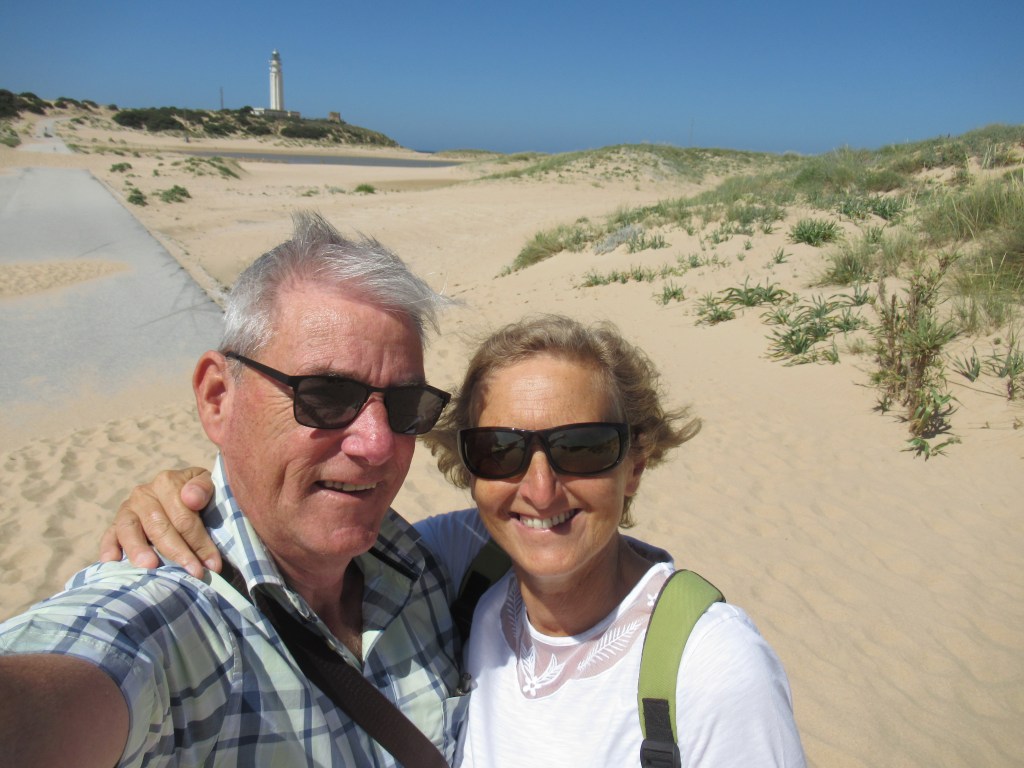
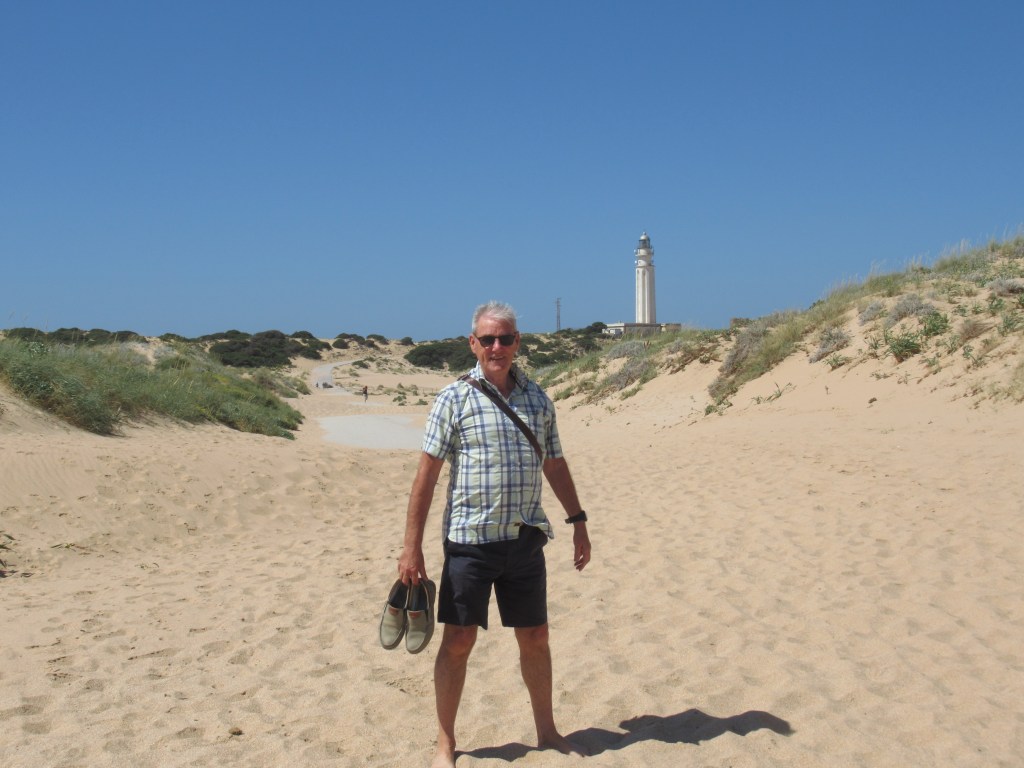
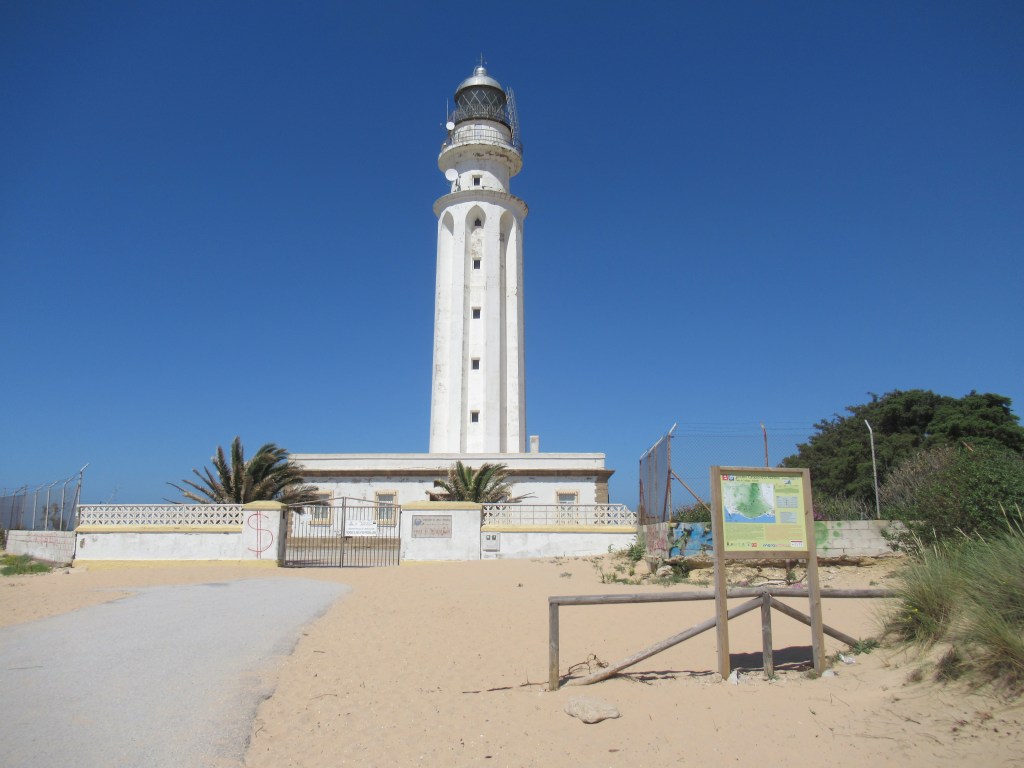

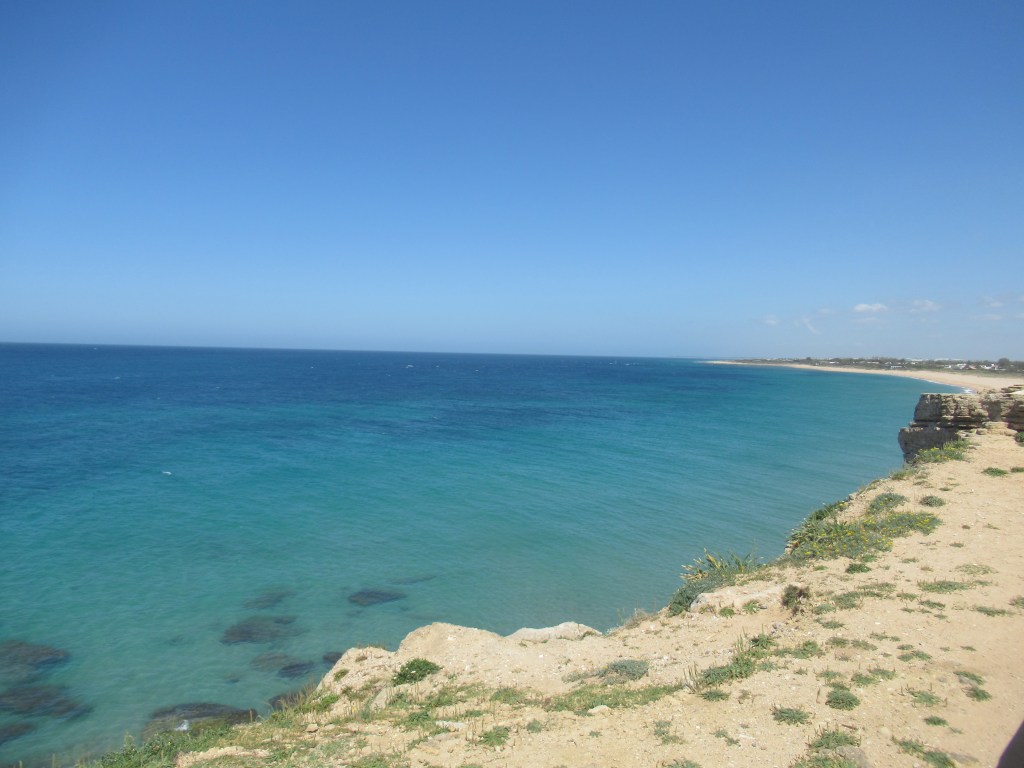
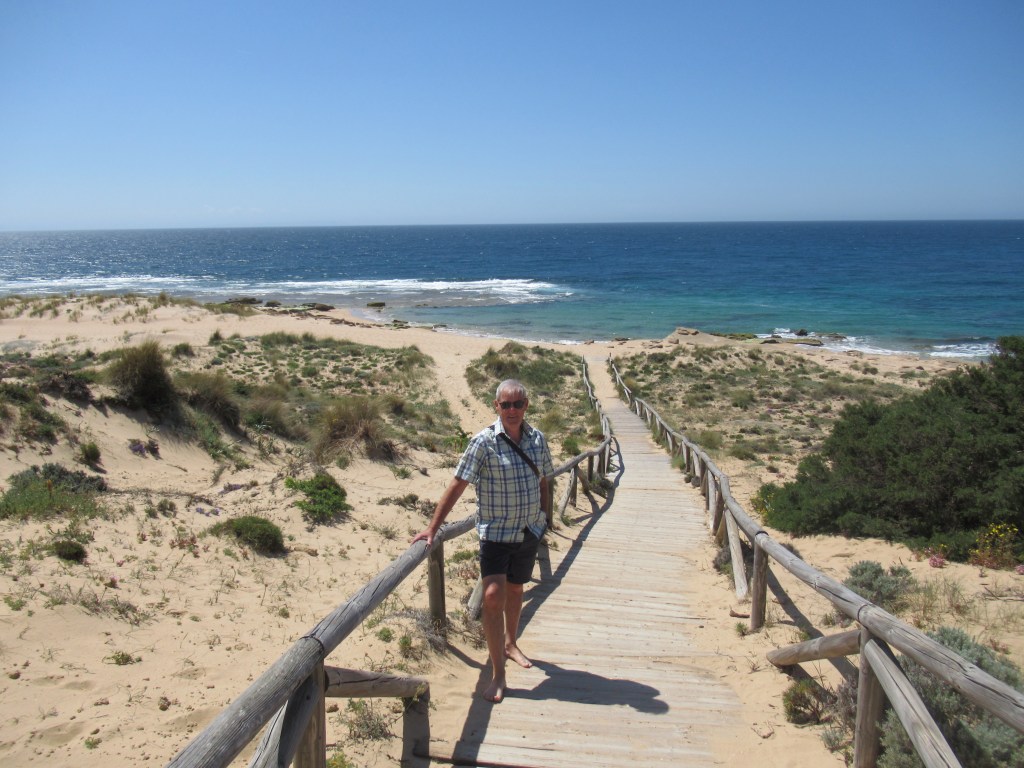
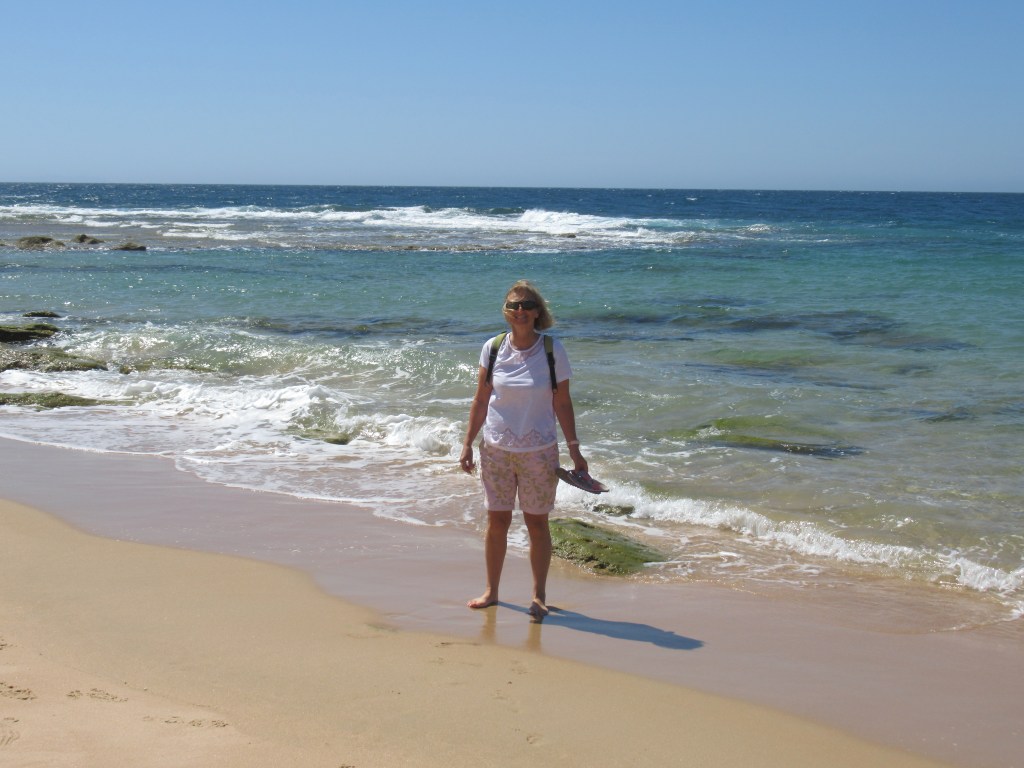
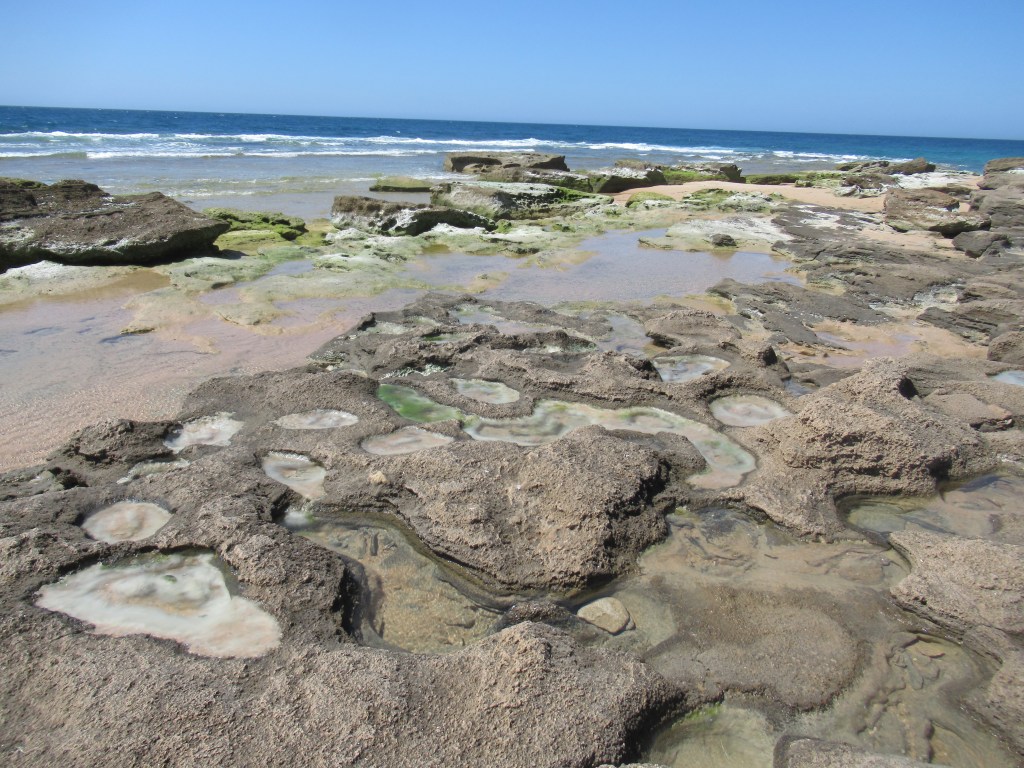
Around the perimeter fence a boardwalk had been erected so we had a stroll, admiring the views and the vast expanse of the surrounding sand dunes, it is quite amazing at the variety of grasses, flowers and shrubs that will grow in sand. There were of course 360 degree views and with the bay, beach and small village of Los Canos de Meca on one side (where we had parked the car), the town and beach of Zahora on the other, and with the for once quite calm Atlantic Ocean stretching out before us, what an idyllic location. Facing West, out to sea, many people come here in the evenings to watch the sunset, we wouldn’t be here that long though. Although there was a tarmac road up to the lighthouse, which was closed off to traffic of the general public, even so, the majority of it was covered in thick but soft golden sand and, with the lighthouse of course being erected on higher ground, walking uphill, barefoot in thick soft sand, it started to tell on the calf muscles, so it was a nice relief when we got to the top. We walked around the lighthouse building, although from outside the tall fence there was not a lot to see and then we decided to descend to the rocky shoreline below, initially via some wooden steps, and then using the crags and rock pools down to the shoreline where we had to zig zag a way around to the sheltered beach area in the bay. Of course we had to dip our toes and have a paddle, it would have been rude not to, but we soon discovered that the Atlantic certainly wasn’t yet at a comfortable swimming temperature 🥶
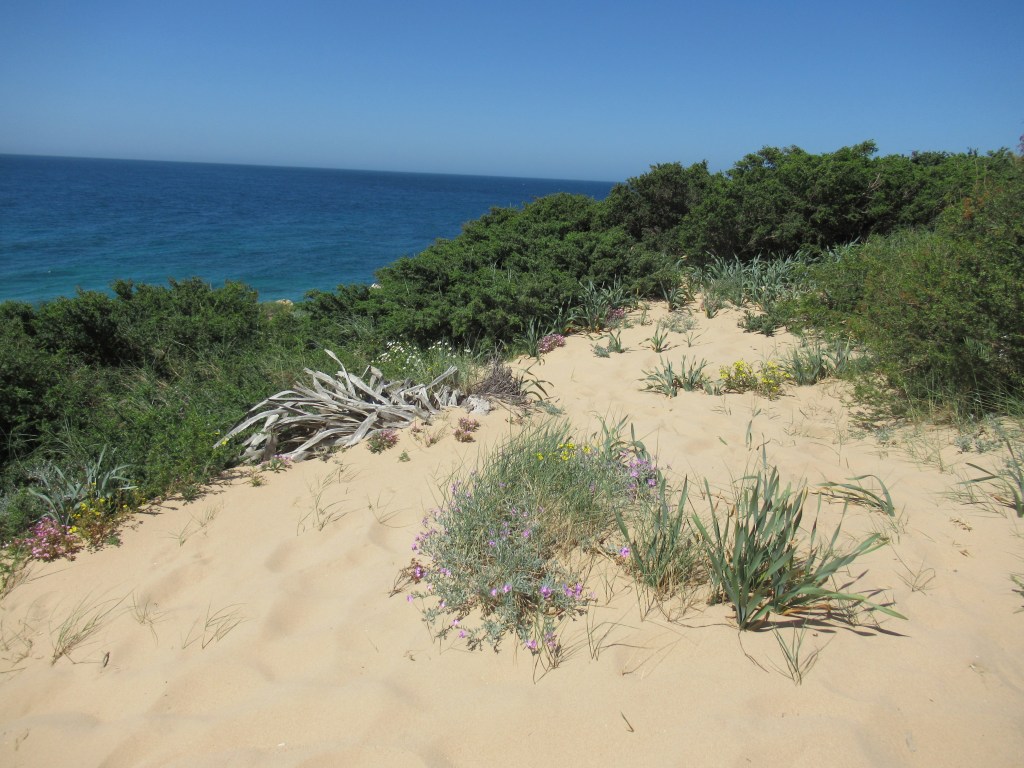
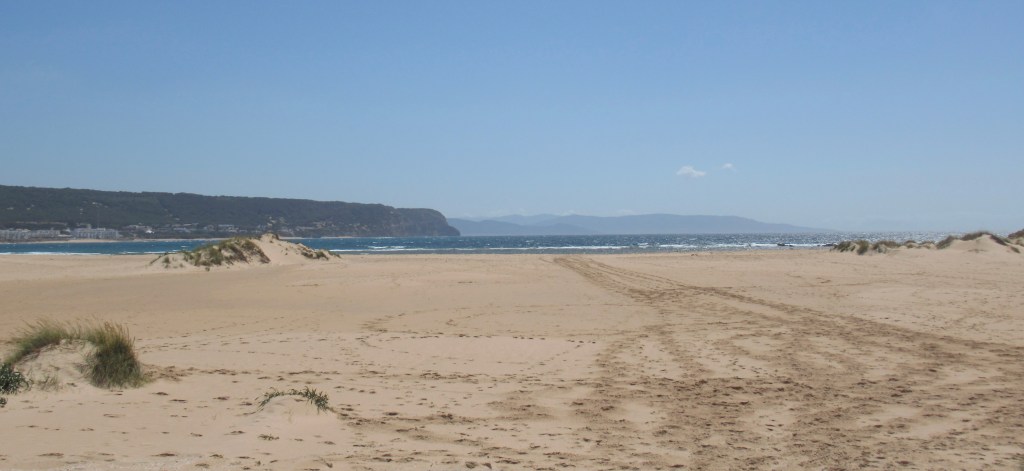
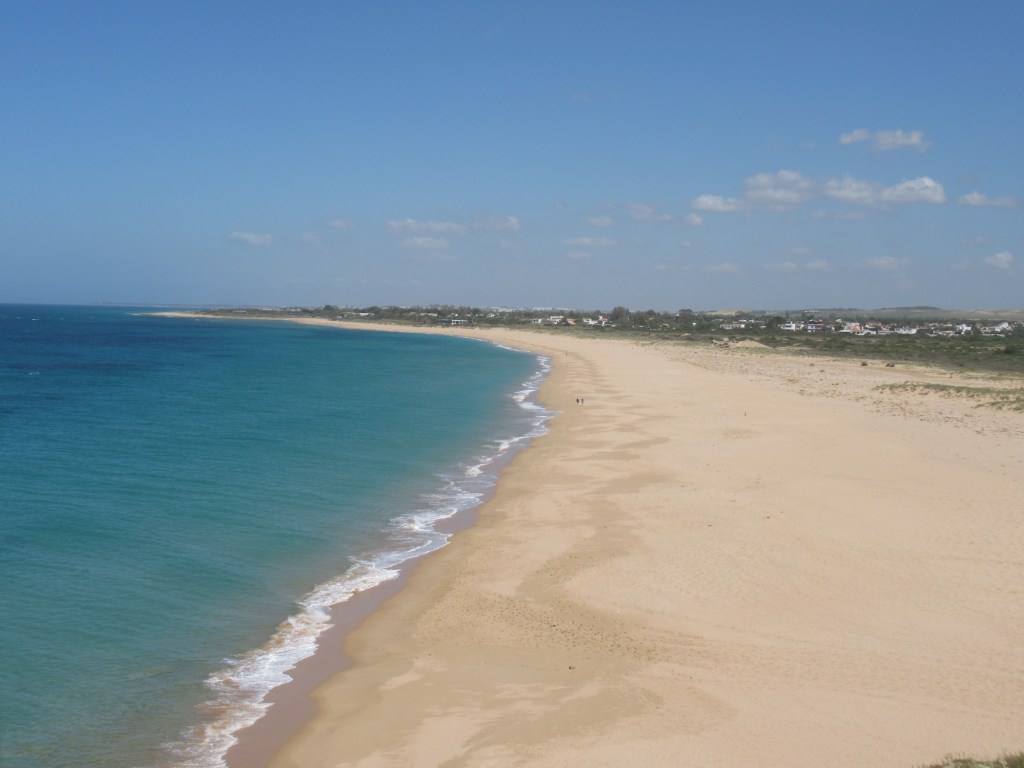


Now when I had initially planned this trip, this had been the ultimate destination, I had not scheduled anything else in to the itinerary, thinking that perhaps we may have found a ‘Chiringuito’ in which to enjoy a casual lunch, we had the sun chairs in the boot of the car, so we could have spent the remainder of the afternoon just doing a spot of sunbathing, before returning home later that afternoon, I really had not made any other plans. There were several hostelries available near the beach, however, neither had we scheduled a late breakfast stop into the proceedings so neither of us were now hungry, albeit it was now a little after 1pm. So, with my OCD buddy feeling quite relaxed we decided to risk conducting some further spontaneous travels, namely making our way 11 Kilometres further down the coastal road, to the seaside town of Barbate.
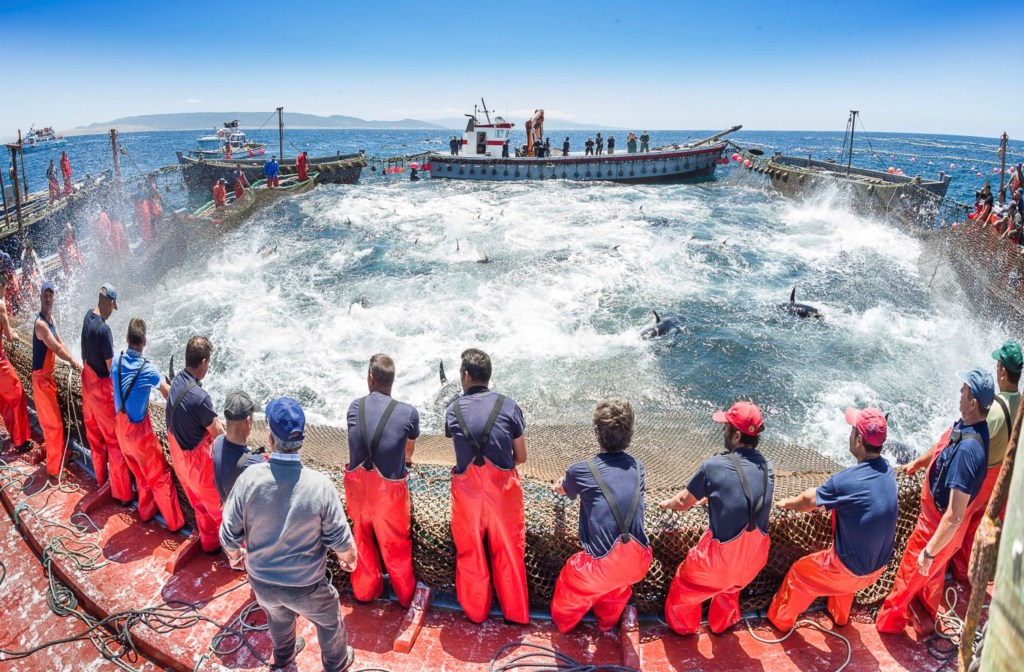
Barbate is located at the mouth of the River Barbate, along the coast east of Cape Trafalgar and within the La Brenda y Marissa’s del Barbate Natural park. Barbate has a long history of fishing stretching back to Roman times when fish salting was at its peak. Along with several other coastal towns along this coastal region of Cadiz Province, it is now renowned for its sustainable Tuna fishing heritage and unique technique of catching them. The town also has an interactive Tuna Industry Museum, but as is usual with us, it was closed at the time that we chose to visit it 🙄

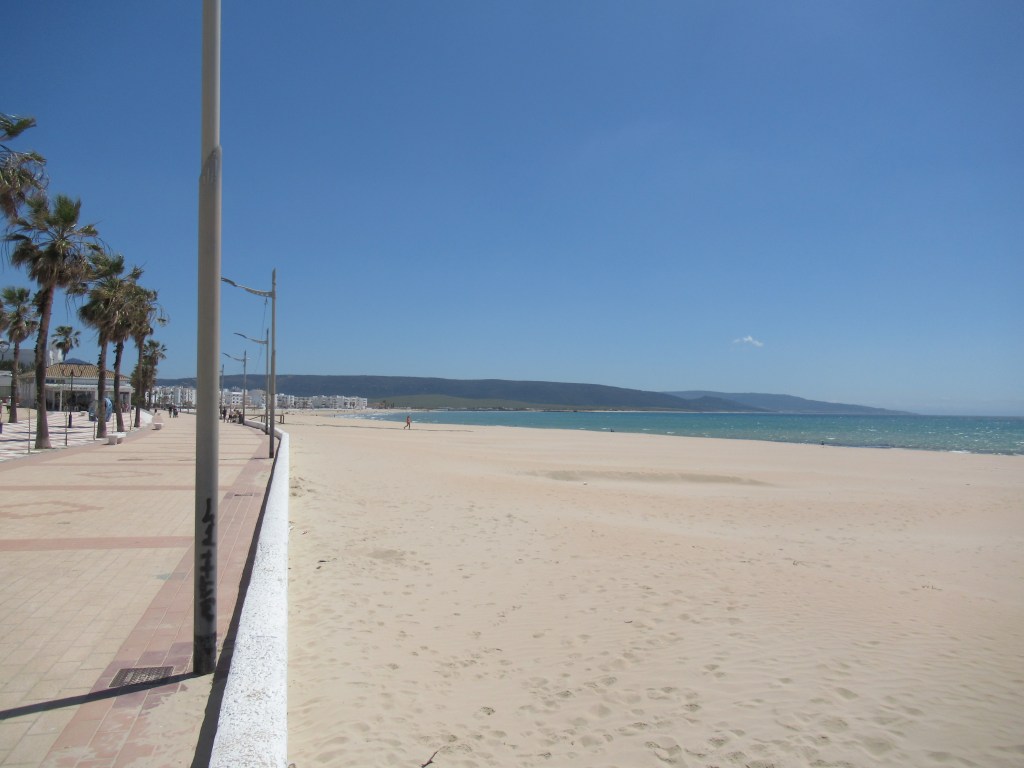
We managed to find a small car park at the entrance to the town, it was ‘Free’ with the added bonus of it having a sun shelter over each bay. A quick look on Google Maps showed that the town had a long seafront promenade, so we just followed our noses and within a few minutes we were there. The beach was vast, the water a beautiful turquoise colour and the sand was once again of the soft and golden variety, but it was very very quiet, everywhere 🤔 Their were rows and rows of Cafe/Bars and Restaurants, and although open, most were empty, or at best, had a couple of people sat at just one table. Fortunately we were still not hungry, but we were beginning to get quite thirsty, so we made our way to the first available Cafe/Bar and with our two small ‘ice-cold’ Cruzcampo beers, we just sat, soaking up the sunshine and enjoying the tranquility of the place.


Now at this stage we had to decide what to do next as there was still more than enough daylight left ? Did we make our way back and have a late afternoon lunch back at our own Marina ? or perhaps we may find somewhere en route and stop there ? Shazza had volunteered to do the drive back and she opted to just return the same way we had come, we could even stop at the same Cafe where we had our late breakfast as they also served lunches, so decision made. However, just a few miles outside of Barbate, we (Shazza 🤭) had a slight misunderstanding with our Sat Nav and so instead of making our way back along the route we had come, we ended up taking the coastal road South towards Tarifa, although it was a much faster and better surfaced road and to be honest it wasn’t a massive deviation. As it turned out, and as we have often discovered during many of our previous nomadic Adventures, a ‘Swerve In The Road’ can sometimes turn out to be a blessing in disguise, we have always said that things happen for a reason ?
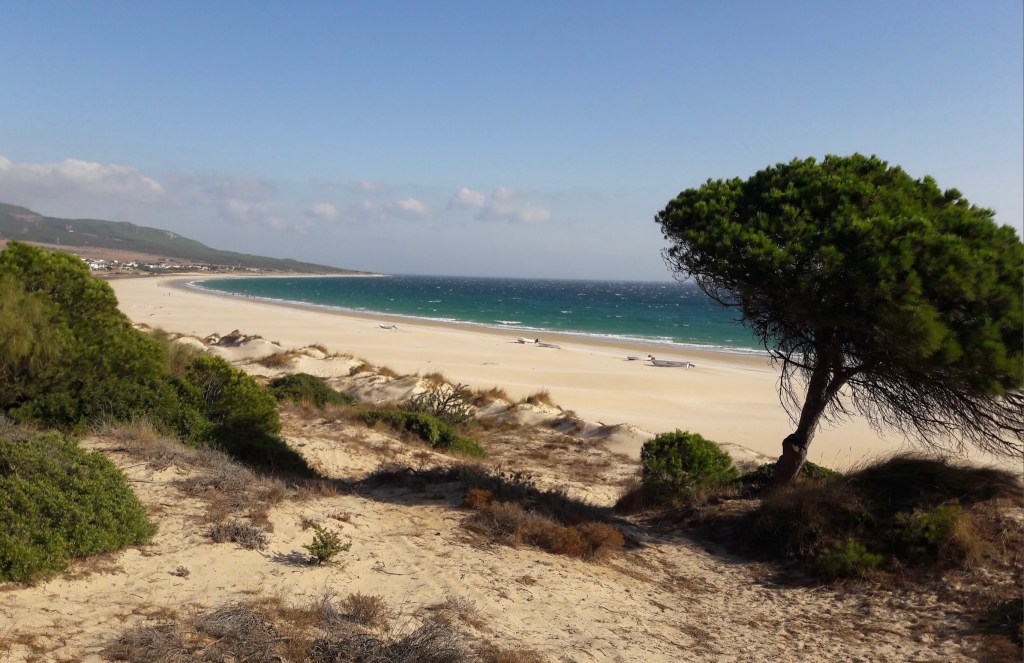
Just a little way out from Tarifa I saw a sign for ‘Bolonia’, now this dislodged a memory that had been stored somewhere in the deep recesses of my brain. Our Spanish neighbour, ‘Miguel’, had once asked, back in the days when we still had our Motorhome, whether we had ever wild-camped at Bolonia Beach, which as it turned out we hadn’t. He had told us how beautiful it was, the glorious beach, the turquoise coloured sea and a big sand dune that you can climb up. So, having reminded Shazza of that conversation she said, “Shall we go and take a look ?”, “Why not” I replied, and so that is how we not only discovered an exquisite tropical looking paradise (See Photo at top of this Page), but where we ended up having a lovely late afternoon fish lunch, washed down with a rather pleasant glass of Anti-Covid Vaccine 🍷 at a wonderful Chiringuito overlooking yet another gorgeous beach.


Well I guess that fate is till working its magic for us from time to time, for had we have not taken the ‘alternative’ route home, then to this day we still would never have visited Bolonia Beach, or found such an idyllic place to enjoy what was to be either a very late lunch, or an early dinner 🤔
We continued to follow the coast road, past Tarifa, where we could still see all the kite sails out on the water, then we turned East towards Algeciras and Gibraltar, this road now very familiar to us from several previous journeys along it, our journey ‘From The Med To The Atlantic’ was almost over, we returned home at just a little after 5:30pm having experienced a most wonderful day, even my OCD buddy had not been perturbed at conducting a number of unplanned deviations, perhaps he too is beginning to learn how to relax into this kind of lifestyle 😉
Until the next ramble……………………….
Hasta Luego Mi Amigos (La Vida Es Buena)


Leave a reply to Eric and Shazza Cancel reply